Sciatica Pain Care in Vancouver
Last updated
Key takeaways
- Sciatica often begins with mechanical stress in the low back or hips.
- We focus on restoring motion, easing nerve irritation, and improving daily movement patterns.
- Plans include gentle care, posture tips, and home drills to support comfortable mobility.
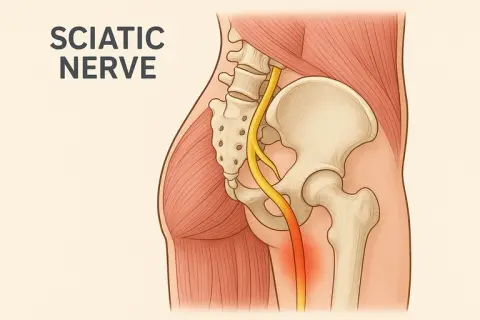
Sciatica can change the way you move through the world. That sharp, burning, or pulling line from the low back into the leg makes simple activities feel unpredictable. Sitting at work becomes a chore. Walking the dog requires planning. Even standing in line at a coffee shop can spark discomfort. Many people search for “chiropractor near me” when the tension won’t ease or when the pain begins to interfere with daily routines. At Revolution Health in Vancouver, we approach sciatic pain with calm, step-by-step plans built around one idea: your body is self-healing and self-organizing. When joints move better and posture stress decreases, the nervous system often functions more smoothly, and the body is able to express more of its natural recovery potential.
Sciatica often comes from mechanical stress, irritated soft tissues, or long-standing movement patterns. Chiropractic care focuses on restoring motion in the spine and hips, improving posture awareness, and teaching simple strategies that support better mobility. We do not treat symptoms in isolation. Instead, we look at how your back, hips, and nervous system work together and help you build habits that allow those structures to share the workload instead of overloading one spot.
One of the four core chiropractic principles is that the body is more capable than we often realize. When tension lowers and motion improves, the nervous system communicates more clearly, and the body does more of its own reorganizing. Another principle is that small mechanical stressors, repeated consistently, can lead to recurring pain. This is why we look closely at the way you sit, bend, walk, and lift. These daily patterns influence the stress on your sciatic nerve far more than most people expect.
Corrective exercises that match your lifestyle
Many cases of sciatic discomfort do not begin with one dramatic event. Instead, they build over months or even years from habits, work positions, old injuries, or repetitive loading. The sciatic nerve becomes irritated when joints in the low back, hips, or pelvis stop moving smoothly. That is why the first step is a clear, simple exam. We watch how you bend, how you step, how you transfer weight from side to side, and where movement feels restricted. We also talk about your workday, your commute, your training habits, and what you want to return to comfortably.
From there, we design a plan that blends gentle chiropractic adjustments, when appropriate, with corrective exercises that take just a minute or two at a time. Long, exhausting rehab routines rarely work because they are hard to maintain. Small, repeated movements, done consistently, tend to create better change with less irritation.
Some of the exercises we use include slow hip rock backs to ease stiffness, light glute activation drills to help the hips share more of the load, and gentle nerve glides that help reduce tension without sharp pulling. These movements should not feel extreme or stressful. They are designed to remind your body how to move in a way that protects irritated tissues.
If you live or work near Olympic Village or Mount Pleasant, we often suggest pairing these drills with short walk loops. Walking tall and slow, without rushing, helps the hips and spine coordinate more naturally. You do not need long workouts; you just need consistent input that supports smoother patterns.
Daily habits also play a major role in calming sciatic irritation. Something as small as a thick wallet in a back pocket or twisting quickly to grab a grocery bag can increase nerve irritation. We do not lecture; we simply help you identify the little habits that may be contributing. One patient swapped out their soft couch for a firmer sitting option during recovery, and within a week noticed less pulling down the leg. Small changes often create meaningful improvements.
Another patient, who worked long hours in tech, came in with sciatic discomfort that made meetings feel intolerable. We combined gentle adjustments, two simple drills, and posture cues he could use at his desk. By week two, sitting felt less sharp. By week four, he could complete a full workday without shifting constantly. Nothing extreme, just consistent steps that matched real life.
Many patients with sciatica also read our Low Back Pain Care in Vancouver page. It explains how posture and movement correction help reduce flare-ups over the long run.
Mobility and flexibility training for sustainable change
After the first stage of relief, we shift toward mobility and flexibility training. This second phase improves the way your back, hips, and pelvis coordinate. Sciatic irritation often decreases as the body begins to distribute load more evenly. When the hips move more naturally, the low back tends to work less defensively, and the nerve has a better environment.
Mobility work also helps people return to activities they care about. For some, that might be gardening without bracing. For others, it could be walking the seawall, strength training at a local gym, or playing with their kids on the living room floor. We focus on daily wins, not unrealistic fitness standards.
Our mobility plan usually includes:• Gentle range-of-motion drills that “polish” stiff joints and help them move without forcing anything.• Light stability work, especially around the glutes, hips, and core, so load is shared instead of concentrated.• Breathing strategies that reduce tension and help movements feel smoother.
We also look at your sitting, standing, and lifting strategies. A computer screen that is too low, a chair without lumbar support, or a habit of twisting while lifting small items can add up over time. We offer practical adjustments, ones you can actually follow. You do not need perfect posture; you just need better patterns most of the time.
A simple early-stage checklist many patients find helpful includes:• Stand every 45 minutes and take slow breaths before sitting again.• Keep items out of back pockets while sitting.• Use a hip hinge when lifting, even for light items.• Choose one hip drill and one core drill to repeat morning and evening for 60–90 seconds.
These small actions help reduce mechanical stress and give your system a chance to quiet irritated pathways.
Our role is to restore motion, guide posture, and teach simple habits that let your body recover at its own pace. If a technique doesn’t feel right, we choose another. Care is collaborative, not one-size-fits-all.
FAQ: Sciatica and chiropractic care
What usually causes sciatica?Often it is a mix of stiff joints, irritated soft tissues, and movement habits that place repeated stress on the nerve. Sometimes a disc issue contributes, but many cases arise from more common mechanical patterns.
Do I need to stop working out or running?Not usually. Gentle, frequent movement tends to support recovery more than prolonged rest. We will tell you which activities are a “yes,” which are a “not yet,” and which to skip temporarily.
How long until I feel improvement?Everyone responds differently. Some people feel changes within days; others progress gradually over several weeks as movement patterns improve. We check in often and adjust the plan as needed.
Is chiropractic safe for sciatica?When delivered by a trained chiropractor, the approaches we use are designed to be gentle and matched to your comfort level. You are always in control, and if something does not feel right, we choose another option.
What happens on the first visit?We talk about your health history, your work and lifestyle, and your goals. Then we examine posture, bending, gait, and strength patterns. Our goal is to explain things clearly and outline a step-by-step plan.
Ready to get moving again?
Sciatic pain can shrink your world, but it does not need to decide how you move, work, or live. If you are looking for careful, step-by-step sciatica pain care in Vancouver, our team at Revolution Health is here to help you build a practical plan that fits your life and goals.
Reviews from our patients
5.0 stars · 132+ reviews on Google (read our reviews on Google, opens in a new tab)Reviews are published by patients on Google. Individual experiences vary.